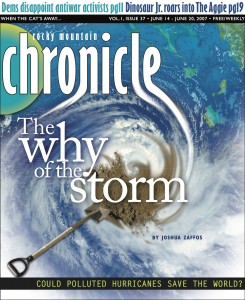
 Many researchers have concluded that climate change is feeding extreme hurricanes, and amplified concerns could bring about the second coming for weather modification. A computer simulation from a Colorado State University professor could be the future of the field — and the federal government’s contingency plan for looming hurricane disasters.
The feature got a mention on a climate-change blog of the journal Nature, and also earned a third-place award for science reporting from the Colorado chapter of the Society of Professional Journalists.
***
The Why of the Storm
Could polluted hurricanes save the world?
By Joshua Zaffos
Rocky Mountain Chronicle, June 14, 2007
The year is 2025, and a Category-5 hurricane is barreling toward the Atlantic coast. If the storm continues on its present course, forecasters predict a 15-foot storm surge, flooding houses along the coast from Charleston, South Carolina to Washington, D.C. With just 72 hours until landfall, FEMA doesn’t call for an evacuation: Instead, a fleet of C-130 cargo planes takes off from Andrews Air Force Base in Maryland and flies into the storm, loaded with a megaton payload of Saharan Desert dust.
Cue Wagner’s “Flight of the Valkyries” as the pilots open the payload doors over the hurricane. As if sprinkling pixie dust, the maneuver tames the weather system: Within a day, the rains diminish, the winds let up, and the storm is downgraded. Tragedy is averted.
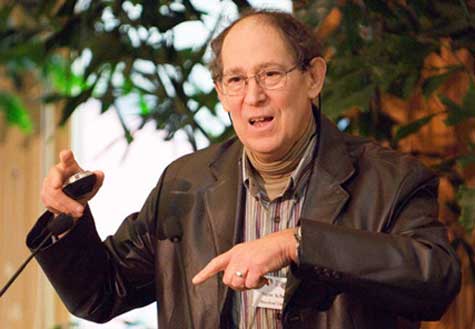
“If you could reduce the intensity by 40 knots, you could save billions in reduced damages,” says Bill Cotton, a Colorado State University professor of atmospheric science, who collaborated with University of Illinois researchers to simulate the dirt-dumping scheme using
the Regional Atmospheric Modeling System, or RAMS, a program Cotton developed with CSU professor emeritus Roger Pielke Sr.
Cotton is seeking federal funds to pursue his theory. With strong financial backing, he estimates that field studies of his dust-busting hurricane treatment could start within 10 years.
Almost 60 years after government scientists first began discussing the idea of toying with the weather, the field of weather modification is again in vogue. Western states are considering cloud seeding — loading clouds with silver iodide — to amp up regional precipitation in order to keep shrinking reservoirs full. And Colorado U.S. Rep. Mark Udall plans to reintroduce legislation that would create a federal weather modification bureau.
Many researchers have concluded that climate change is feeding extreme hurricanes, and an amplified fear of more Katrinas could bring about the second coming for weather modification. Cotton’s simulation could be the future of the field — and the federal government’s contingency plan for looming hurricane disasters.
But, then, just because something can be done doesn’t mean it should.
Slowing the Skater
Inside the CSU Atmospheric Sciences Building, Stephen Saleeby is at a loss to describe the workings of Cotton’s atmospheric modeling program. RAMS simulates the formations of clouds and storms based on a variety of conditions, such as regional wind speed, relative humidity and temperature. Saleeby, a research associate of Cotton’s, says programming isn’t quite as simple as plugging in a few numbers and then clicking the mouse to see how the simulated weather plays out.
The model consists of tens of thousands of lines of code. Saleeby can run some basic simulations on his desktop computer, but the larger analyses of hurricane pathways or cloud-seeding operations are handled through a cluster of up to 20 processors. One of Saleeby’s projects, studying the development of the Southwest monsoon season, takes the clustered computers three days to process.
RAMS allows Cotton, Saleeby and others to forecast how altering weather systems might affect snowfall, the duration of a drought, or a hurricane’s response to plane-loads of fine dust.
Such modeling has become highly sophisticated since the field of weather modification was born 60 years ago, when General Electric scientists discovered that silver iodide could increase precipitation in clouds. Researchers thought they could boost rain and snowfall and suppress hail and tornadoes.
The federal government began spending millions of dollars on a national weather modification program in 1959, partly motivated by the Cold War and the Soviet Union’s successful space launch of Sputnik two years earlier. The U.S.S.R. might have first dibson outer space, but the U.S. government wanted control of the atmosphere and the weather. From 1967 through 1981, the federal government never spent less than $9.9 million a year on weather modification. The bill topped out at $18.7 million in 1972.
Researchers conducted hurricane reduction experiments under Project Stormfury starting in 1962. Stormfury scientists seeded three hurricanes
in the 1960s but weren’t able to consistently affect the storms. A treatment of Hurricane Debbie in 1969 coincided with a 30 percent drop in the storm’s wind speed, but scientists couldn’t conclude that natural factors didn’t account for the results.
In the case of hurricanes, researchers assumed that dropping silver iodide onto specific storm clouds would cause “supercooled” water droplets to freeze. That process would create latent heat on the storm’s edge and, according to the theory, slow its speed.
“We use the analogy of the spinning skater,” says William Woodley, a federal researcher in Miami during the ’60s and ’70s, who flew into hurricanes to conduct experiments for Project Stormfury.
Whirling ’round and ’round, a figure skater pulls her arms into her body, turning faster and faster. That might help a performer score a few extra tenths of
a point from the judges, but out in the ocean, it’s the type of development that turns a tropical storm into
a hurricane — and then a major hurricane. Weather modification, as attempted through Stormfury and now modeled by Cotton, coaxes the hurricane to stick out her arms and slow down.
“The instrumentation wasn’t all that [in the 1960s]. The modeling was crude,” says Woodley, now a Littleton-based weather modification consultant. Another significant part of the problem was that Stormfury’s theoretical assumptions didn’t pan out.
Cloud-seeding experiments to augment precipitation for farming proved similarly disappointing. When adverse events, like floods or blizzards, coincided with modification projects, citizens blamed the government. People also faulted drought in one region on cloud seeding in an adjacent area. Federal research dollars began to taper in the late ’70s, and the cash flow stopped completely after 1985.
Today, weather modification is strictly a private and/or academic affair, but even without government cash, the improvements in computer modeling have advanced the field.
“What I can do today, I couldn’t even have dreamed of in graduate school,” Cotton says.
In Dust We Trust
Researchers are still trying to slow down the whirling skater, but the simulation, put forth by Cotton and his University of Illinois colleagues, uses a new technique, different from Stormfury’s.
In the simulation, tiny dust particles are dropped onto the storm. Very small raindrops form, which are less likely to collide in the clouds and more likely to evaporate before they fall, cooling the air. The upshot is a tamer storm: Wind speeds decrease 50 knots after the dust particles are introduced in the simulation. In the case of Katrina, a dust drop could have mellowed the storm at its fiercest point from Category-5 to Category-2 on the Saffir-Simpson scale.
“[This] is much more powerful than anything that was considered back in the Stormfury days,” Cotton says, sitting in his office, photos of heavy and ominous clouds hanging on the walls.
The theory has natural inspiration: African dust, which can impede the formation of tropical storms before they move across the Atlantic.
“We’ve observed that if a big dust storm comes along [in Africa], that tends to weaken a storm,” Cotton says.
A similar simulation by professor Daniel Rosenfeld and Woodley, also just published this year, produced the same results through the release of “submicron hygroscopic” — extremely minuscule and moisture-attracting — particles. Rosenfeld now has a provisional patent on the process, Woodley says.
Airlifting a desert dust storm sounds like a massive operation. The million-dollar question is, How much dirt are we talking about, and what’s that going to do to a coastal city?
Cotton can’t give a specific amount of dirt. That’s
one of the next steps after
he receives more funding.
But the delivery of the dust specks — each so small that 100 million of them could fit on a penny, Cotton estimates — would be a logistical issue and would require a convoy of cargo aircraft, like the C-130s.
Not to worry, Cotton says. A storm “would rain out the crud before it hits shore.”
In terms of clouding the
sky, the amount of dust is
roughly equivalent to the pollution levels of a major urban city, Cotton adds. It would be
as if a hurricane were to rev through the Atlantic and then pass through downtown St. Louis.
Pollution is the Solution
African dust pollution isn’t the same as the haze that hangs over a city, but the particles in the air act the
same. Cotton and his associates have titled their peer- reviewed article, soon to appear in The Journal of Weather Modification, “Should we consider polluting hurricanes to reduce their intensity?” The title is purposely provocative: According to most climate scientists, manmade pollution is already tinkering with the weather.
Auto exhaust and coal-fired power plant emissions
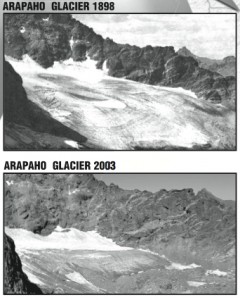
are already poking and prodding at the figure skater. (In another study, Cotton and graduate students observed that increased urban pollution from vehicles and coal-fired power plants have coincided with — and seemingly caused — decreased precipitation along the Front Range.) The collective impact of this pollution, contributing to melting glaciers and warming oceans, unfortunately, doesn’t deter the hurricanes. In fact, it makes them more persistent.
Scientists have found that warming sea-surface temperatures are causing more ferocious hurricanes, like Katrina and Rita, although that particular correlation isn’t quite as definitive as other impacts of human-caused climate change.
Recent studies by researchers at MIT, Woods Hole Oceanographic Institute, and the National Center
for Atmospheric Research (NCAR) in Boulder have concluded that warming oceans will cause fiercer hurricanes, though not necessarily more storms.
“We think global climate change will cause more intense hurricanes and, in particular, much heavier rainfall,” says Kevin Trenberth, head of NCAR’s Climate Analysis Section and a lead author on several reports by the Intergovernmental Panel on Climate Change (IPCC) that affirm global warming is occurring.
“The debate, if any, is the cause [of more intense hurricanes],” Trenberth says, although “the IPCC has very clearly stated that global warming is occurring and anyone who disagrees has their head in the sand.”
Still, there are other researchers who say historical hurricane records can’t be compared with modern monitoring. Also, factors like wind shear — the difference in wind speed at varying heights — and massive deviations of the ocean-atmosphere system, like El Niño, play key roles in hurricane development and intensity. Therefore, we shouldn’t presume that recent hurricane seasons are abnormal or unprecedented, or that climate change is the cause.
Cotton downplays the link between more intense hurricanes and climate change as “a lot of arm waving.”
It’s almost shocking to find that someone who has
dedicated his life to figuring out how to modify the weather, including methods that simulate urban pollution, is unconvinced that we’re unintentionally changing the climate.
Cotton says he is, indeed, a “climate skeptic,” and even calls the projections of the IPCC, put forth by 600 scientists, “back of the envelope numbers.” The skepticism lands him in the company of a more notorious
and outspoken skeptic, CSU’s hurricane- forecasting guru William Gray, whose office is around the corner from Cotton’s.
“I don’t think we can say with scientific confidence that current trends are due to human activity,” Cotton says. “I’m not buying into the warming trend being influenced by humans.”
After years of studying clouds and the atmosphere, and trying to change the weather, Cotton says he hasn’t seen enough evidence that rising global temperatures are anything more than “natural variability” of the planet.
“My involvement with weather modification, I take that skeptical view,” Cotton says. “I’m a modeler by trade, so that makes me very skeptical of models, including my own.”
But Cotton qualifies his uncertainty: On a scale from negative ten (being a staunch climate- change doubter) to ten (being a firm believer), Cotton rates himself as a negative one or a negative two, and Gray as a negative seven.
“I just think the jury’s still out, but I’m trying to find out the other side,” Cotton explains. “But I try to stay away from the personality issues.”
The irony here is that any renewed interest in weather modification, including the possibility of federal funding for the practice, is clearly tied to fears of how climate change might lead to longer droughts, bigger floods and wilder hurricanes. Colorado Congressman Mark Udall has twice introduced legislation
to establish a federal weather modification program that could draw millions of research dollars and put the government back in the cloud-seeding and hurricane-taming business. Udall plans to reintroduce the bill again
this congressional session (Sen. Kay Bailey Hutchinson of Texas has sponsored the same bill in the Senate during past sessions, as well).
The Ethical Storm
We can no longer claim that everyone is talking about the weather, but that no one is doing anything about it. We are doing something, whether we mean to or approve of it.
“Weather modification is a reality,” says Woodley, the former Stormfury scientist in Littleton. “Forget about anything I might do deliberately. We humans are changing the weather [with pollution]. My question is, If we’re doing this inadvertently, why can’t we do this — if we have our wits about it — advertently?”
That’s one of the questions Connie Uliasz has considered carefully over the past few years. Uliasz is completing her master’s thesis, “Ethical Issues in the Use of Weather Modification Technologies,” through CSU’s philosophy department.
“You’re probably talking to the world’s expert on the ethics of weather modification,” she says, half-jokingly.
Uliasz is properly schooled for that title. Her undergraduate background is
in philosophy, and she has studied with well-known CSU bioethicist Bernie Rollin and, to a lesser extent, Colorado State professor Holmes Rolston, “the Father
of Environmental Ethics.” She also has experience in atmospheric sciences, and at CSU, she has worked with Bill Cotton and helped manage professor Scott Denning’s “BioCycle” climate
change research group.
“I spent a long time
trying to understand the
science, years of that,
before I could even start
with the ethics,” Uliasz
says. Few researchers ever attempt a cross over. “They” — scientists — “don’t even think about ethics,” she charges.
Weather modification is at an ethical disadvantage on several counts, Uliasz says: “There’s some good evidence it actually works, but it’s difficult to prove, and you don’t know what you’re going to get [in terms of experiment results]. And you’re not going to solve questions in the long run.”
Weather modification, Uliasz continues, can “sidetrack people from really making the hard decisions. It’s almost a red herring of a technological fix. And Americans, especially, love their technological fixes.”
Americans also have a Category-5 fear
of hurricanes in the haunting aftermath of Katrina. Our broken-levee blues may be out of proportion compared to our concerns over other risks, like coastal flooding.
A March 2007 Gallup survey shows 49 percent of Americans fear more intense hurricanes from global warming, and we’re more worried about another climate- change-fueled hurricane than drought, flood, an increased prevalence of disease, or a loss of coastal areas.
This year’s hurricane season started before its usual June 1 date, when Subtropical Storm Andrea formed in May. Hurricane forecasters, like CSU’s Gray,
are projecting that this year could turn
out a lot like 2005, and if another Katrina, or even an Andrew or a Hugo, rocks the Atlantic coast, Congress will only be more inclined to consider a quick fix. But instead of slowing down the skater, maybe we should concentrate on encouraging her not to spin faster.
“It seems like it could be better to spend [federal] money when hurricanes come, instead of trying to disperse them,” Uliasz says, the ethical coin flipping inside her head. “But, then, if Katrina were a Category-2 instead of a 5, we’d still have New Orleans. I don’t know how many more really awful hurricanes we could have before we say, ‘Let’s try anything.’”